
Understand the need
Clarify the audience, business challenge, and desired outcomes.
Corporate Training & Development
Practical programmes in digital transformation, AI, entrepreneurship, leadership, customer experience and operational excellence. Tailored to your organisation and delivered in English or Arabic.
English catalogue · 48 programmes · PDF
Booking live virtual training from 10 December 2026. Programmes are available in English or Arabic, with scheduling agreed around your team’s requirements.
Find your focus
Start with a focused programme or combine complementary skills into a learning journey. Select an area to explore its programmes.
The programme catalogue
Explore all 48 programmes. Open a programme for its scope, audience and learning outcomes, then add it to your enquiry.
Understand how digital transformation reshapes customer value, operations, and organisational capabilities, and identify opportunities across people, processes, data, technology, and culture.
Business leaders / Transformation managers / Operations directors / Project sponsors
Apply practical transformation frameworks to structure discovery, analyse current capabilities, prioritise initiatives, and connect strategy, execution, adoption, and measurement within a coherent approach.
Business leaders / Transformation managers / Operations directors / Project sponsors
Assess organisational maturity across people, processes, technology, data, and governance; identify capability gaps and define readiness priorities for a proposed transformation initiative.
Business leaders / Transformation managers / Operations directors / Project sponsors
Translate business goals into a digital strategy and phased roadmap, with prioritised initiatives, accountable owners, dependencies, resource considerations, and meaningful progress measures.
Business leaders / Transformation managers / Operations directors / Project sponsors
Explore how digital capabilities can reshape value propositions, revenue logic, roles, processes, and service delivery, then outline a practical future operating model.
Business leaders / Transformation managers / Operations directors / Project sponsors
Develop a structured transformation business case by defining the problem, comparing options, testing assumptions, estimating benefits and costs, and establishing evaluation criteria.
Business leaders / Transformation managers / Operations directors / Project sponsors
Design governance routines that clarify sponsorship, accountability, decision rights, and escalation, while tracking adoption, delivery progress, expected benefits, and emerging implementation issues.
Business leaders / Transformation managers / Operations directors / Project sponsors
Develop a practical understanding of AI capabilities, limitations, and business applications, and learn to recognise suitable tasks, necessary inputs, and useful evaluation questions.
Business leaders / Department managers / Operations teams / Digital champions
Use structured prompts to support writing, summarisation, planning, analysis, and communication, while practising source checks, iteration, and review within approved workplace tools.
Business leaders / Department managers / Operations teams / Digital champions
Shape an AI adoption approach that links business objectives with capability development, use-case selection, sponsorship, workforce involvement, governance, and a manageable implementation roadmap.
Business leaders / Department managers / Operations teams / Digital champions
Identify AI opportunities in everyday work and prioritise them using business value, feasibility, data readiness, complexity, and clearly defined pilot objectives and measures.
Business leaders / Department managers / Operations teams / Digital champions
Explore AI-assisted responses, case summaries, knowledge support, quality review, and feedback analysis, with practical exercises that emphasise accuracy, service context, and employee judgement.
Business leaders / Department managers / Operations teams / Digital champions
Map business workflows and explore how AI agents can support tasks, approvals, and handovers, with clear boundaries, exception handling, monitoring, and human intervention.
Business leaders / Department managers / Operations teams / Digital champions
Establish practical habits for reviewing AI outputs, handling information within company policies, recognising uncertainty, and assigning human responsibility for consequential workplace decisions.
Business leaders / Department managers / Operations teams / Digital champions
Explore the responsibilities and decisions of entrepreneurship, develop a problem-solving mindset, and translate an initial ambition into clear assumptions, priorities, and achievable actions.
Aspiring entrepreneurs / Startup founders / Incubator participants / Early-stage teams
Plan customer conversations and simple experiments to test problem, audience, and demand assumptions, then use the evidence to refine or reconsider a business idea.
Aspiring entrepreneurs / Startup founders / Incubator participants / Early-stage teams
Use the Business Model Canvas and value proposition tools to clarify customers, benefits, channels, revenue logic, key activities, resources, partners, and costs.
Aspiring entrepreneurs / Startup founders / Incubator participants / Early-stage teams
Define a focused minimum viable product, prioritise essential features, establish learning goals, and plan iterative testing that informs the next stage of product development.
Aspiring entrepreneurs / Startup founders / Incubator participants / Early-stage teams
Develop an AI-enabled venture concept by connecting a customer problem with suitable capabilities, realistic product scope, evaluation needs, and a practical route to validation.
Aspiring entrepreneurs / Startup founders / Incubator participants / Early-stage teams
Select an initial customer segment, shape an offer, test acquisition channels, and build an actionable plan for reaching, engaging, and learning from first customers.
Aspiring entrepreneurs / Startup founders / Incubator participants / Early-stage teams
Practise B2B discovery, offer development, proposal conversations, and partnership evaluation, with an emphasis on clear value, mutual expectations, structured follow-up, and relationship development.
Aspiring entrepreneurs / Startup founders / Incubator participants / Early-stage teams
Build a practical startup plan covering objectives, revenue assumptions, operating costs, cash flow, runway, and scenarios that support informed commercial decisions and resource allocation.
Aspiring entrepreneurs / Startup founders / Incubator participants / Early-stage teams
Structure a clear startup narrative and pitch deck, connect claims to evidence, explain the business model and funding needs, and prepare for investor questions.
Aspiring entrepreneurs / Startup founders / Incubator participants / Early-stage teams
Work through founder priorities in structured mentoring sessions, translate goals into milestones, review assumptions and progress, and develop focused actions for the venture's next stage.
Aspiring entrepreneurs / Startup founders / Incubator participants / Early-stage teams
Apply a human-centred problem-solving approach to understand needs, frame challenges, generate options, prototype potential solutions, and learn from feedback before committing to implementation.
Department heads / Change leads / Project managers / Innovation teams
Develop and evaluate new ideas within an established organisation, combining opportunity identification, experimentation, internal sponsorship, and practical planning for a small-scale innovation initiative.
Department heads / Change leads / Project managers / Innovation teams
Plan employee adoption by assessing change impacts, involving stakeholders, communicating clearly, addressing concerns, and defining reinforcement activities that help new behaviours become everyday practice.
Department heads / Change leads / Project managers / Innovation teams
Lead teams through changing roles, tools, and workflows by setting clear expectations, supporting capability development, maintaining dialogue, and establishing practical routines for adoption.
Department heads / Change leads / Project managers / Innovation teams
Map stakeholder interests and responsibilities, improve cross-functional communication, resolve handover challenges, and build agreements that strengthen collaboration, ownership, and progress on shared business priorities.
Department heads / Change leads / Project managers / Innovation teams
Practise listening, questioning, empathy, and clear communication across customer interactions, while managing expectations, taking ownership, and agreeing practical next steps that support consistent service.
Customer service teams / CX managers / Frontline supervisors / Complaints teams
Develop structured approaches to difficult conversations and complaints, practising de-escalation, investigation, response, escalation, and follow-up to rebuild confidence and clarify resolution responsibilities.
Customer service teams / CX managers / Frontline supervisors / Complaints teams
Map a customer journey across touchpoints and internal handovers, identify friction and unmet needs, and prioritise experience improvements with clear owners and measures.
Customer service teams / CX managers / Frontline supervisors / Complaints teams
Examine service across voice, email, chat, messaging, and other touchpoints, and design consistent communication, context sharing, ownership, and handovers throughout the customer journey.
Customer service teams / CX managers / Frontline supervisors / Complaints teams
Organise customer feedback from different sources, identify recurring themes, distinguish evidence from assumptions, and translate insights into prioritised service improvements and follow-up actions.
Customer service teams / CX managers / Frontline supervisors / Complaints teams
Examine the operating model, workflows, roles, service controls, and management routines of a contact centre, and identify practical opportunities to improve coordination and delivery.
Contact centre managers / Team leaders / Operations heads / Service delivery managers
Build core supervisory skills in daily briefings, prioritisation, escalation handling, accountability, and performance conversations, supported by practical exercises and an actionable team development plan.
Contact centre managers / Team leaders / Operations heads / Service delivery managers
Diagnose employee development needs, practise constructive feedback and coaching conversations, and create specific improvement actions with clear expectations, support, and structured follow-up.
Contact centre managers / Team leaders / Operations heads / Service delivery managers
Plan the processes, roles, channels, knowledge, training, and management controls needed for a contact centre launch, using readiness checks and clearly assigned responsibilities.
Contact centre managers / Team leaders / Operations heads / Service delivery managers
Explore demand patterns, workload, staffing capacity, scheduling considerations, and service trade-offs, and use simple scenarios to identify gaps and inform practical resource decisions.
Contact centre managers / Team leaders / Operations heads / Service delivery managers
Define service expectations, governance routines, performance reviews, and escalation paths for outsourcing relationships, while examining provider accountability, operational risks, and opportunities for joint improvement.
Contact centre managers / Team leaders / Operations heads / Service delivery managers
Develop and apply quality criteria, practise consistent evaluation through calibration, and translate review findings into focused coaching, improvement actions, and follow-up discussions.
Quality teams / Operations managers / Process owners / Service supervisors
Define an operational problem, examine available evidence, test potential causes, and plan corrective actions with ownership and measures that support learning and continued improvement.
Quality teams / Operations managers / Process owners / Service supervisors
Choose and interpret service indicators, clarify definitions and targets, and design review routines that connect performance results with customer outcomes, operational decisions, and accountability.
Quality teams / Operations managers / Process owners / Service supervisors
Create clear procedures and knowledge articles that support everyday work, with practical guidance on structure, usability, ownership, review cycles, and controlled content updates.
Quality teams / Operations managers / Process owners / Service supervisors
Map service activities and handovers, identify delays, rework, and bottlenecks, and design an improved process with defined roles, decision points, and measures.
Quality teams / Operations managers / Process owners / Service supervisors
Practise the client's configured CRM workflows for customer records, leads, opportunities, activities, or service cases, with attention to useful information, consistency, and daily adoption.
CRM users / Sales and service teams / Internal trainers / Business managers
Prepare internal champions and trainers to explain CRM workflows, facilitate practical exercises, support colleagues, gather feedback, and reinforce consistent system use across teams.
CRM users / Sales and service teams / Internal trainers / Business managers
Interpret business dashboards, examine data quality and metric definitions, ask better analytical questions, and translate performance patterns into evidence-informed management actions and follow-up.
CRM users / Sales and service teams / Internal trainers / Business managers
Try a shorter keyword or another training area. You can also ask us to help choose a programme.
Help me chooseDesigned around your team
We tailor the sector context, employee roles, starting capability and learning objectives—not just the presentation slides.
Clarify the audience, business challenge, and desired outcomes.
Adapt examples, exercises, and materials to the participants.
Use guided activities, case studies, simulations, or practical labs.
Provide useful templates, action plans, and agreed follow-up activities.
Booking live virtual training from 10 December 2026. Programmes are available in English or Arabic, with scheduling agreed around your team’s requirements.
From 10 December 2026, delivery is coordinated from Paris, France (Europe/Paris). Your organisation’s preferred time zone will be agreed during planning.

Your programme lead
Founder & CEO, Quantara AI
Ahmed Zoher combines customer operations and service leadership experience with an MBA in Digital Transformation with AI and practical founder experience through Quantara AI. Selected as a Startup Entrepreneur Mentor for the Dubai Chamber Digital — Create AI Agents Championship initiative, he supports entrepreneurs in developing ideas, refining business models and planning their next steps.
His work spans contact centres, customer operations and digital transformation, with founder experience through Quantara AI and its Quantara Flow AI platform.
Recognition & milestones

Quantara AI was selected from 800 applications to exhibit at Thara Connect.


Ahmed Zoher was selected as a Startup Entrepreneur Mentor for the Dubai Chamber Digital — Create AI Agents Championship initiative.
These exhibition and mentorship selections are not client endorsements or training accreditations.
Let’s shape your programme
Choose one programme, several programmes or a training area. Not sure where to start? We can help you shape a useful learning journey.
Booking live virtual training from 10 December 2026. Programmes are available in English or Arabic, with scheduling agreed around your team’s requirements.
For HR and L&D teams, business leaders, training partners, incubators and founders.
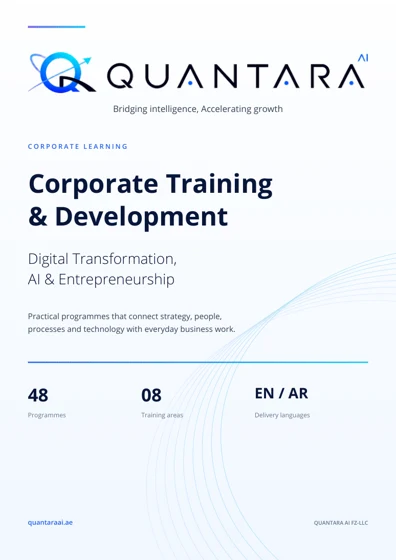
English PDF · all 48 programmes. Delivery in English or Arabic.
Fields marked * are required. No payment is requested.